Emerald green has earned its place as one of the most sophisticated color choices for living rooms in 2026. This jewel tone brings depth, warmth, and a connection to nature that few other shades can match. Whether someone’s planning a complete room overhaul or just looking to add a few strategic accents, emerald green offers versatility that works with both traditional and contemporary design styles. The color’s ability to anchor a space while still feeling fresh makes it particularly valuable for homeowners tired of the endless gray-and-white schemes that have dominated for the past decade. With the right approach, emerald green can elevate a living room from ordinary to memorable without requiring a complete renovation.
Table of Contents
ToggleKey Takeaways
- Emerald green living room decor brings sophistication and staying power by combining luxury with practicality—it hides wear better than light neutrals and creates visual interest without constant maintenance.
- Test emerald green paint samples on multiple walls for at least 48 hours, observing color shifts under different lighting conditions and choosing shades with undertones (blue or yellow) that complement your existing fixtures and wood tones.
- Emerald green furniture pieces, particularly velvet-upholstered sofas or accent chairs, serve as powerful focal points; quality construction matters more with bold colors, with mid-range three-seater sofas typically priced between $1,200–$2,800.
- An accent wall behind the sofa or fireplace creates a balanced approach to emerald green living room design in standard-height residential spaces, allowing you to maintain brightness with warm white or pale sage on remaining walls.
- Start with low-commitment accessories like throw pillows, blankets, and decorative objects to test emerald green before investing in paint or furniture—odd-numbered pillow arrangements and layered textures create visual depth.
- Pair emerald green with complementary colors like gold or brass metallics, blush pink accents, or navy blue, and incorporate mixed textures (velvet, jute, ceramic, wood) to prevent the space from feeling flat or monotonous.
Why Emerald Green Is the Perfect Living Room Color Choice
Emerald green sits at the intersection of luxury and livability. Unlike trendy colors that feel dated within a few years, this shade has centuries of design history backing it up. The color references both natural elements, forest canopies, moss-covered stones, and precious gemstones, giving it a dual personality that works in rustic and refined settings alike.
From a practical standpoint, emerald green hides wear better than lighter neutrals. Fabric upholstery in this shade won’t show every coffee spill or pet hair the way beige does. Paint in emerald tones creates visual interest without the maintenance headaches of white walls that need constant touch-ups.
The color also affects room perception in useful ways. Emerald green makes large, cold rooms feel more intimate without shrinking the space visually. In smaller living rooms, using it on a single accent wall or in furniture pieces adds richness without overwhelming the square footage. The shade works particularly well in rooms with northern exposure, where it compensates for cooler natural light.
Psychologically, green tones promote relaxation, an ideal quality for a living room that serves as both a family gathering spot and a decompression zone after work. The darker value of emerald provides that calming effect while maintaining enough saturation to feel energizing rather than dull.
Choosing the Right Emerald Green Shade for Your Space
Not all emerald greens are created equal. Paint chips that look similar in the store can read completely differently on a wall once natural and artificial light hit them. The key lies in understanding undertones and testing properly.
Emerald green typically contains blue undertones, which give it that jewel-like quality. Some formulations lean more toward teal (higher blue content), while others pull closer to forest green (more yellow). For living rooms with warm wood tones or brass fixtures, an emerald with slight yellow undertones prevents clashing. Rooms with chrome, marble, or cool-toned furniture benefit from emerald shades with stronger blue notes.
Lighting conditions make or break color selection. Natural daylight reveals the truest color, but most living rooms also rely heavily on artificial light in evening hours. LED bulbs with a color temperature around 2700K (warm white) complement emerald green without distorting it. Cooler LED temperatures above 3000K can make the green appear muddy or gray.
Before committing to a full paint job, test samples on at least two walls, one that receives direct light and one in shadow. Paint at least a 2×2-foot section rather than relying on small swatches. Observe the color at different times of day for at least 48 hours. This step prevents the common mistake of choosing a shade that looked perfect at noon but turns swampy under evening lamps.
Emerald Green Furniture: Statement Pieces That Steal the Show
An emerald green sofa or accent chair creates an instant focal point, but the commitment level differs significantly from paint. Furniture in this shade requires confidence and careful planning around existing elements in the room.
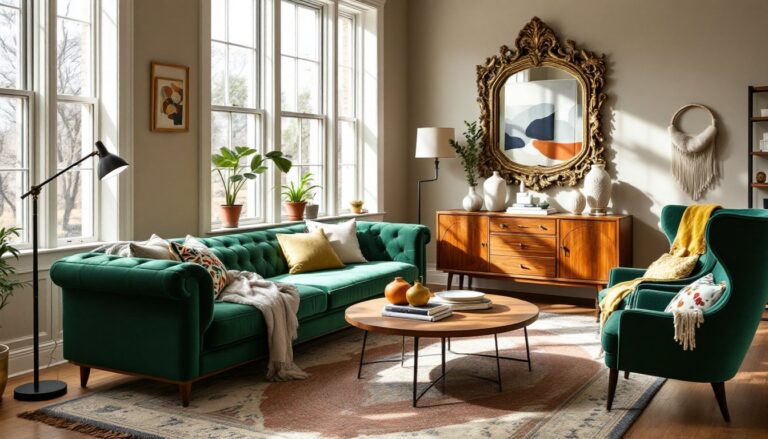
Velvet upholstery remains the go-to fabric choice for emerald green furniture. The pile creates depth variations that make the color shimmer subtly as people move around the room. Performance velvets, treated with stain-resistant coatings, offer that luxe appearance with practical durability for households with kids or pets. Brands specifically engineer these fabrics to withstand 25,000+ double rubs (the industry abrasion standard).
Leather in emerald green provides a completely different aesthetic, more masculine and vintage. Top-grain leather ages well in this color, developing a patina that enhances rather than degrades the appearance. But, leather requires more maintenance than fabric and shows scratches more readily.
For cautious decorators, an upholstered accent chair offers a lower-stakes entry point than a full sofa. A single emerald green wingback or mid-century modern lounge chair can anchor a reading nook without dominating the entire room. Pair it with a brass floor lamp and a neutral ottoman, and the space gains sophistication without visual overwhelm.
When budgeting for emerald green furniture, quality matters more than with neutral pieces. A cheap sofa in this color reads as a mistake rather than a bargain. Mid-range pricing for a well-constructed emerald green sofa typically runs $1,200-$2,800 for a three-seater, depending on region and retailer. Custom upholstery brings costs higher but ensures proper scale and fabric quality for the specific space.
Accent Walls and Paint Techniques for Emerald Green Living Rooms
Painting an entire living room in emerald green works beautifully in spaces with high ceilings and abundant natural light. In more typical residential proportions, 8-foot ceilings, standard window sizes, an accent wall often delivers better results.
The wall behind the sofa or the fireplace wall makes the most logical choice for color placement. This approach creates a backdrop that frames furniture and decor without closing in the space. The remaining walls typically work best in warm white, cream, or very pale sage to maintain brightness and visual flow.
Surface preparation determines paint success more than brand choice. Fill any nail holes or cracks with spackle, sand smooth with 150-grit sandpaper, and prime with a gray-tinted primer. Standard white primer doesn’t provide enough coverage under dark colors, expect to see patchiness and require extra coats. Gray primer reduces the number of finish coats needed from four or five down to two or three.
Paint finish affects both durability and appearance. Eggshell or satin finishes work best for living room walls, they’re easier to clean than flat paint while avoiding the reflective quality of semi-gloss that highlights wall imperfections. One gallon of quality paint covers approximately 350-400 square feet with proper primer underneath.
For renters or commitment-phobes, peel-and-stick wallpaper in emerald green patterns provides a reversible option. Modern removable wallpapers adhere well to painted drywall and come off cleanly when leases end. But, they won’t work on textured walls or fresh paint (wait 30 days minimum). Application requires two people, a level, a squeegee, and patience, air bubbles and misaligned seams look worse in bold colors than subtle patterns.
Geometric or botanical wallpaper patterns in emerald tones can add visual interest on a single wall without the solid-color commitment, offering design flexibility that paint alone doesn’t provide.
Accessorizing with Emerald Green: Pillows, Throws, and Decor
Accessories offer the lowest-risk way to introduce emerald green into a living room. Throw pillows, blankets, and decorative objects can test the color without major investment or permanent changes.
Pillow combinations work best in odd numbers, three or five pillows on a sofa rather than two or four. Mix emerald green with complementary patterns and textures: a solid velvet emerald pillow, a geometric print with emerald and gold, and a neutral linen with subtle texture. Pillow inserts should be down-alternative or feather-down blend at minimum, cheap polyester fill looks lumpy and flat within weeks.
Throw blankets in emerald green serve double duty as decor and functional comfort. Chunky knit blankets add tactile interest, while lightweight cotton or linen throws work for year-round use. Drape one over the arm of a neutral sofa or fold it at the foot of a chaise to introduce the color without committing wall space.
Decorative objects in emerald green create visual anchors throughout the room. Glass vases, ceramic planters, picture frames, or even a collection of vintage emerald bottles on a bookshelf can tie the color scheme together. These smaller touches work especially well when distributed across multiple surfaces, coffee table, console table, and built-in shelving, rather than clustered in one spot.
Plants in emerald green planters reinforce the connection to nature while adding actual greenery. A large potted fiddle-leaf fig or monstera in an emerald ceramic planter combines two trending elements into one practical piece. For homeowners exploring design cohesion, live plants in coordinated containers bridge color choices throughout connected spaces.
Area rugs with emerald green elements provide another layer of color without permanent installation. Oriental or Persian-style rugs often incorporate emerald alongside rust, navy, and cream, a combination that grounds the space and hides dirt better than solid colors. For modern interiors, geometric patterns or color-block designs in emerald and neutrals maintain contemporary style.
Complementary Color Palettes and Material Pairings
Emerald green doesn’t exist in isolation, it needs supporting colors and materials to reach its full potential.
Metallic accents elevate emerald from pretty to polished. Brass and gold tones create warm, luxurious combinations that feel both classic and current. Cabinet hardware, picture frames, lamp bases, and curtain rods in warm metals enhance emerald’s richness. For a cooler aesthetic, chrome or brushed nickel works with emerald greens that lean toward teal undertones.
Wood tones require careful consideration. Walnut, mahogany, and other rich brown woods complement emerald beautifully, adding depth without competing. Lighter woods like oak or maple can work but need enough contrast, very pale woods may wash out beside deep emerald. For homeowners considering overall room balance, wood finishes should align across all visible furniture pieces.
Blush pink and emerald green create an unexpectedly sophisticated pairing. The combination works because pink’s warmth balances emerald’s coolness. Use blush sparingly, a single accent chair, pillow grouping, or table lamp, rather than splitting the room 50/50 between colors.
Navy blue and emerald layer jewel tones for drama without garishness. This combination works particularly well with white or cream as a third element to prevent the space from feeling too dark. According to designers featured on interior design platforms, navy-and-emerald pairings gained significant traction in 2025 and continue strong into 2026.
Material variety prevents emerald-heavy rooms from feeling flat. Combine smooth velvet with rough jute, glossy ceramic with matte wood, and reflective metal with absorbent fabric. These textural contrasts create visual interest even in a limited color palette.
For wall art selections, abstract pieces incorporating emerald with gold leaf, botanical prints featuring deep green foliage, or even black-and-white photography in emerald-painted frames can extend the color story without overwhelming the space. Experts at design-focused publications frequently recommend limiting bold color to 30-40% of the room’s visual weight, with neutrals filling the remaining space.
Conclusion
Emerald green living room decor offers staying power that trend-driven colors can’t match. Whether someone commits to a full accent wall, invests in a statement sofa, or starts small with accessories, this shade brings sophistication and versatility to any space. The key lies in understanding undertones, testing properly before committing to large purchases, and pairing emerald with complementary colors and materials that enhance rather than compete. With proper planning and execution, an emerald green living room becomes a space that feels both current and timeless, a combination that’s increasingly rare in home design.